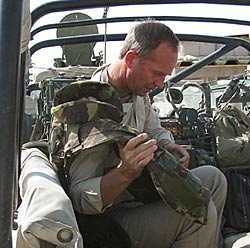
Dutch Defence Mininster Henk Kamp dons a flak jacket during his September 2003 visit to Base Samawah.
The Dutch government will install an independent commission to investigate the process of interrogation by Dutch military intelligence in Iraq. The investigation will look into the conduct of these intelligence officers during interrogation of fifteen Iraqi prisoners during the month of October in 2003 in the Iraqi province of Muthanna.
According to the Dutch leading morningpaper De Volkskrant Dutch military officers were involved in the torture of dozens of Iraqi prisoners in the southern Iraq. In the fall of 2003, a cell of the Military Intelligence and Security Service (MIVD) carried out "hard-handed interrogations".
The Dutch Military Police had carried out an investigation at that time and concluded that the prisoners had to wear snow glasses to prevent them to recognize their interrogaters. They also abused prisoners by hosing them with water to keep them awake and blasting them with loud noises during heavy-handed interrogations.
The Dutch Minister of Defense Henk Kamp said that the Military Police concluded that no unlawful conduct took place. He knew that there was an investigation by the Military Police, but was notified by their conclusions only this morning.
Military trade union AFMP chairman Wim van den Burg was quoted by Dutch news agency ANP as saying: "Those in leadership positions should have intervened immediately."
Sleep deprivation is considered to be torture. Interrogation victims are kept awake for several days, then when they are finally allowed to fall asleep, suddenly awakened and questioned. Nicole Bieske, a spokeswoman for Amnesty International Australia, has stated, "At the very least it [sleep deprivation] is cruel, inhumane and degrading. If used for prolonged periods of time it is torture."
Sleep deprivation in particular has been used as an interrogation tool in different places around the globe throughout the past century, with questionable results. It was a tactic favoured by the KGB and the Japanese in PoW camps in World War Two. In Northern Ireland, British troops used it in crackdowns on the IRA until a European court ruled in a minority opinion that it constitutes torture. In 2001, the measure was being used on Afghan guerrillas in secret CIA detention centers, according to the testimony of both prisoners and soldiers.
Amnesty International says claims of this type of torture have increased in the past couple of years. The Pentagon has denied torturing Iraqi prisoners, but it has admitted using sleep deprivation and playing loud rock music to break prisoners' resistance.
In 2004 former US Defense Secretary Donald Rumsfeld defended military interrogation techniques in Iraq, rejecting complaints that they violate international rules. Rumsfeld told a Senate committee in December 2004 that Pentagon lawyers had approved methods such as sleep deprivation and dietary changes as well as rules permitting prisoners to be made to assume stress positions.
The use of sleep deprivation has been a common interrogation tactic in Afghanistan, Iraq, and Guantánamo. Detainees held at various locations in Afghanistan in 2002 and 2003 describe routinely being deprived of sleep. Similarly, at Guantánamo, sleep deprivation was regularly employed, and continued in 2004. Detainees held in January, March and April 2004 in Mosul and Tikrit, Iraq reported being subject to sleep deprivation.
Arjan El Fassed is cofounder of Electronic Iraq and is based in The Netherlands