Marie-Helene Rousseau, Institute for War and Peace Reporting, Mar 29, 2008
NEW YORK - Somewhere in Baghdad, a family sits down to
dinner. Heaped plates of food line the long table. A man sits at the
head, fork in hand. Beside him, a youngish woman with immaculately
shaped eyebrows turns to speak with a young girl. Forks and spoons face
upwards on still empty flowered plates.
Somewhere in
Baghdad, members of the same family watch explosions going off -- not
through the comforting, detached glare of a television screen but
through the frame of a window.
Farah Nosh
Immortalised in stark black and white, these two photographs
of everyday life in Iraq confront visitors to the Pomegranate Art
Gallery in the heart of SoHo, New York City. Behind the lens is
Canadian-born Iraqi photojournalist, Farah Nosh.
The gallery, the only one in New York City to specialise in
modern Middle Eastern art, was established by Oded Halahmy, an
Iraqi-Jewish sculptor. The gallery has received much media attention
for its acclaimed first exhibit, "The Iraqi Phoenix: Ashes to Art". Its
current exhibit, "Contemporary Iraqi Art" features the work of 16 Iraqi
artists, many of whom have fled Iraq and now live scattered across
Europe and the Middle East.
Nosh's intimate portrayals of the time she spent in Baghdad
living with relatives stand out in an exhibit largely consisting of
abstract and figurative art.
Although Nosh is the only photojournalist in the exhibit, her
work speaks to the dual struggle she says much of the art in this
post-Saddam Hussein category represents -- the artists' healing, while
at the same time dealing with the fresh wounds inflicted by the war.
For Farah Nosh, a 2003 journey to Iraq was the first time she
came into direct contact with her heritage. Growing up with Iraqi
parents in Vancouver, she said she "didn't have a sense of being
Iraqi." She was fresh out of school in 2002, when the U.S. -led
overthrow of the Taliban government in Afghanistan had started.
"[The invasion of] Iraq was being talked about but no one
believed it would happen," she said. In September 2002, she left home
to cover the country's uncertain future. "I have a really strong
emotional connection to what is happening," she said, "I'm drawn to
being in the Middle East."
Nosh decided to join her relatives to get a more intimate
sense of they were going through. The experience led to the series of
photographs, "The Other Side of War". "I don't think they really
understood what I was doing," Nosh said of her family, "but they would
make fun of me for having my camera everywhere."
Although Iraqis are in their homes, the war seeps through,
Nosh said, speaking of the time explosions went off in front of her
family's window. "Family I" captures this moment, showing her aunts and
cousins staring out the window, their worried reflections in an
adjacent mirror. They were watching Iraqi army officials picking up
their dead, scrambling through the chaos taking place on the street
where her cousins used to walk to school. Sadness pervaded the house.
She said, "It was hard to have happy and light moments in the house,
there was a heaviness."
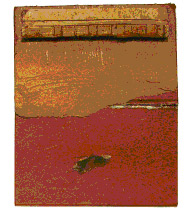
Qasim Sabti
Qasim Sabti is the only artist of the 16 who remains in
Baghdad. His work showcases some other "casualties" of the 2003
bombings -- the books that were destroyed in the looting of Baghdad's
Academy of Fine Arts, where Sabti had both studied and taught. Sabti
took the "survivors", the book covers, and made collages. In the
exhibit's catalogue, Sabti refers to his work as representing the
resilience of cultural life.
The destruction of this cultural heritage is a theme of many
of the artist's works. Echoes of lost and desecrated art can be found
in Hanna Mal-allah's abstract piece, "The Looting of the Museum of
Baghdad", a wood canvas that she cut and burned, bearing the traces of
Iraqi ceramic tiles painted on by Mal-allah.
Of the artists in this post-Hussein era, Esam Pasha perhaps
best represents the transition to U.S. occupation. At the end of
Hussein's rule, Pasha was the first artist to paint over a mural
depicting him in Baghdad, replacing it with his own artistic
interpretation of Iraq's history. Pasha would also become the first
Iraqi to obtain a visa to the U.S., where he now resides in
Connecticut.
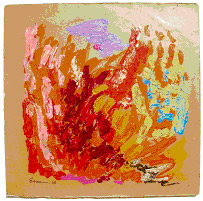
Esam Pasha
As buildings burned and bombs fell around him in April 2003,
Pasha had run out of art supplies, so he turned to melting crayons to
make his series, "Tears of Wax".
In stark contrast to Nosh's wartime reportage and Pasha's
portraits of molten crayon, the art of Amal Alwan and Naziha Rashid is
reminiscent of a more peaceful time in Baghdad. Rashid's nostalgia
comes through in her paintings of the Iraqi villages and countryside of
the past.
Oded Halahmy also treasures his memories of Iraq, referring to
it as "the cradle of civilisation, the land of milk and honey." His
memories of Iraq are also free from the sectarian strife that has
bubbled over today.
"The Jewish community was living in harmony. There was no
fighting between Sunnis and Shiites." His memories are fitting in an
exhibition featuring Sunnis, Shiites, Jews, and Kurds. "My aim is to
bring all ethnic groups in one space," he said.
In his SoHo gallery, far from his childhood home, Halahmy
still clings to memories of pomegranates and palm trees. "I am out of
Iraq," he says, "but Iraq remains in me for life."
All rights reserved, IPS - Inter Press Service (2008). Total or partial publication, retransmission or sale forbidden.