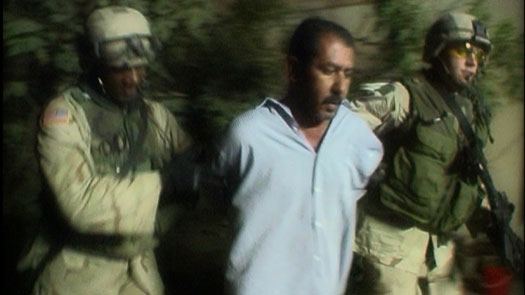
Yunis Khatayer Abbas arrested at his home on 9/23/03. (Nomados LLC/Red Envelope Entertainment)
It could have been a moment out of the reality show Cops. Men in uniform break through the door of a house and take "wrongdoers" into custody. All we viewers know is that there is "good intelligence" that some brothers live here, and they're involved in bomb-making for a terrorist cell. Menace hangs in the air. We see captured men on their knees in the yard. Are they terrorists? One man, his hands tied behind his back, loses patience. "I am journalist," he complains in broken but perfectly understandable English. "You mistake this." His captors tell him to shut up, and the tied-up man parrots back what he hears, anger seeping into his voice. "Shut up, shut up. I know 'shut up.' Always 'shut up' in Iraq." At which point he is taken out of his house, dumped in a truck, and whisked off to a detention facility with his brothers.
This haunting moment stuck with the man behind the camera, Michael Tucker. The year was 2003. Tucker was filming in Baghad during the early months of the US occupation for what would become the critically acclaimed documentary Gunner Palace. Tucker was embedded with the soldiers so when the journalist was turned over to military police, his story thread ended. But something about the man haunted Tucker, as it will anyone who sees Tucker's new film co-directed with his wife Petra Epperlein.
The Prisoner or: How I planned to Kill Tony Blair begins at the moment when Tucker first crossed paths with Yunis Khatayer Abbas, and then goes on to explore who this man was, why he was arrested, and what became of him in the months to follow.
It's a surprising turn of events for Americans used to seeing the credits roll when the authorities get their man in Cops. But Tucker and Epperlein leave the focus locked on Yunis, and as the dignity of this man emerges, a universal story about the terrible price of the Iraq War emerges as well.
We learn Yunis is indeed a journalist, and that years earlier had run afoul of Saddam Hussein. We learn that he was tortured by Uday Hussein's henchmen because he had dared to criticize the regime. We learn that he was skeptical about the American invasion but hopeful at the same time. Maybe, just maybe, Yunis thought, he will be free to write what he wants.
And then he runs afoul of the Americans. The filmmakers call his turn through the detention centers of the occupation forces "an absurd comedy of errors." It's a Kafkaesque nightmare. Under interrogation, Yunis is accused of planning to murder Tony Blair. He laughs when he hears this, and in the film, as he recounts the story, he is laughing again. But it's laughter without joy, because despite the absurdity of the charge and the absence of any evidence, Yunis and his brothers spent 8 months in detention at Abu Ghraib.
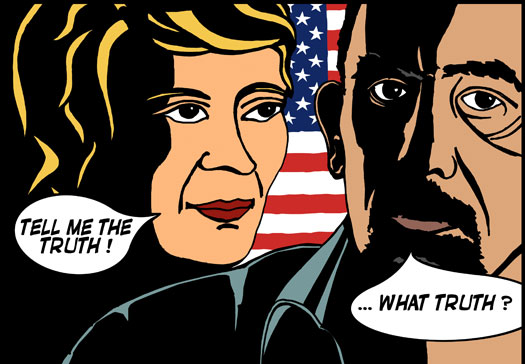
The Prisoner uses comic book illustration to tell stories from Yuni's detention and interrogation. (Nomados LLC/Red Envelope Entertainment)
By now, most people are familiar with Abu Ghraib's "hard site," where some of the worst documented abuses of the war took place. Less known is what happened where Yunis was held at Abu Ghraib's Camp Ganci, the "soft site" that held captives of little or no intelligence value. By this time, it's clear there were no credible charges against Yunis. So when Yunis describes how thousands in the camp suffered from filthy conditions, food shortages, and insurgent attacks, and when he tells us the only way he could document what he was seeing was to keep a secret diary on his underwear, when he shows us the names of the men who died senselessly from neglect or insurgent attack while in detention, and when the prison guard Yunis calls "the good soldier" shows up in the film to corroborate his entire story, the chilling force of his journey sinks in.
What is America doing in Iraq? Though no one says it explicitly, what Yunis is describing is a concentration camp, where innocent civilians suffer indefinite imprisonment under horrifying conditions with no semblance of due process. At the South by Southwest film festival where I saw The Prisoner, director Michel Tucker called it a conspiracy of indifference. That revelation alone is reason enough to see the film, but another is the presence of "the good soldier," Benjamin Thompson. A twenty-something reservist who worked in real estate before he was deployed, Thompson, like Yunis, struggles to maintain his humanity in an inhumane place. His story is ultimately a hopeful one, that a few "good soldiers" are able to make a difference.
But the heart and hero of the story is Yunis Abbas. He's no Rambo or Harrison Ford, the American pop idols he is familiar with. He doesn't save lives, but with quiet poise, he does what he can. He tries to protect his brothers. He tries to keep others safe. He tells truths. He is a journalist demanding to be heard, a man bearing witness to the indignities of war. The filmmakers let his story come to life through cinema verite footage, and when he disappears into detention, they employ stylized comic book illustrations that are mesmerizing and give his words emotional heft. In the end, Yunis is left broken but intact, an inspiration to anyone who faces their own struggle. Some may wonder what any new film about Iraq could add to an already crowded marketplace. The answer, I think, is that itis time for Iraqis to be allowed to tell their story. Yunis is a worthy spokesman.
Co- Directed and Co-Produced by Michael Tucker and Petra Epperlein (Gunner Palace). THE PRISONER OR: HOW I PLANNED TO KILL TONY BLAIR opens in select theaters starting March 23rd.
David Boodell is a writer and filmmaker who lives in Los Angeles. His most recent film, Facing Life: The Retrial of Evan Zimmerman, premiered last year on A&E. He is currently writing a book.