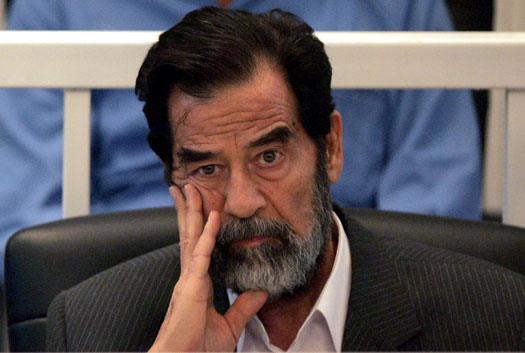
Saddam Hussein listens to the Presiding Judge Rizgur Ameen Hana Al-Saedi as his trial begins in a heavily fortified courthouse in Baghdad's Green Zone October 15, 2005. AFP PHOTO/POOL/BOB STRONG
On Sunday, November 5, 2006, the High Tribunal in Iraq sentenced the deposed Iraqi dictator Saddam Hussein to death by hanging for ordering the murder of 148 Shi'ite residents of Dujail in 1982.
The verdict marked the end of a dramatic and dramatically flawed trial. Responding to the verdict, Amnesty International, in a statement, noted that "political interference undermined the independence and impartiality of the court, causing the first presiding judge to resign and blocking the appointment of another, and the court failed to take adequate measures to ensure the protection of witnesses and defense lawyers, three of whom were assassinated during the course of the trial. Saddam Hussein was also denied access to legal counsel for the first year after his arrest, and complaints by his lawyers throughout the trial relating to the proceedings do not appear to have been adequately answered by the tribunal"
Malcolm Smart, the organization's representative for the Middle East, said, "This trial should have been a major contribution towards establishing justice and the rule of law in Iraq, and in ensuring truth and accountability for the massive human rights violations perpetrated by Saddam Hussein's rule...In practice, it has been a shabby affair, marred by serious flaws that call into question the capacity of the tribunal, as currently established, to administer justice fairly, in conformity with international standards."
Iraqis were divided over the sentence, with some celebrating and others protesting. Also divided were the loved ones of Hussein's infinite list of victims. Some were clearly satisfied with the punishment. Others were conflicted.
Rakan Hamma Ali, 76, of Halabja, lost his wife and two of his sons in the infamous chemical attack there. Responding to word of Hussein's death sentence, he said: "Me and my only son are still suffering respiratory diseases and no-one is paying attention to us. We don't care if Saddam is sentenced to death or not, we just want politicians to stop making use of our tragedy for their personal benefit."
Hawnaz Askewan Rizgar, 34, of Dujail was 10 when his entire family was killed. "Saddam has been sentenced to death," he said, "but it will never take away my suffering of 24 years."
Follow the reaction to the Hussein verdict here...we'll be updating this page frequently...
See video footage of the reading of the verdict and Saddam Hussein's response here.
"Can any human power at this point deliver "just desserts" to someone who has committed actions like those undertaken by Saddam, Joseph Kony, or other perpetrators of extremely harmful deeds? How would we even start to think about what 'just desserts' might be in such cases?" Blogger and Christian Science Monitor columnist Helena Cobban suggests a framework for analyzing the Saddam Hussein verdict and its effects in Iraq
"Saddam Hussein doesn't have many friends here," writes Emad Mekay from Cairo, "but the death sentence handed down Sunday against the former Iraqi president has invited accusations that the announcement was timed to influence the U.S. congressional elections set for Tuesday, only two days after the verdict...It is not the first time legal maneuvering in the case seems to have been scheduled for maximum benefit to the Bush administration. In August, the trial recessed only to reconvene on Sep. 11, the anniversary of the al Qaeda terror attacks on the United States.
Statement, Reporters Without Borders (6 November 2006)
"Reporters Without Borders today condemned the Iraqi government’s decision yesterday to close down two privately-owned TV stations for “inciting violence and murder” by screening footage of protests against former President Saddam Hussein’s death sentence. The main daily newspapers have also been suspended for three days beginning yesterday under a curfew decreed prior to the verdict."
"The guilty verdict in the trial of former Iraqi President Saddam Hussein and seven other defendants for crimes against humanity against inhabitants of the Iraqi town of Dujail is undermined by serious flaws in the proceedings, according to research undertaken by Human Rights Watch over the past year.
Statement, Amnesty International (6 November 2006)
Amnesty International deplores the decision of the Supreme Iraqi Criminal Tribunal (SICT) to impose the death sentence on Saddam Hussein and two of his seven co-accused after a trial which was deeply flawed and unfair. The former Iraqi dictator was sentenced today in connection with the killing of 148 people from al-Dujail village after an attempt to assassinate him there in 1982. The trial, which began in October 2005 almost two years after Saddam Hussein was captured by US forces, ended last July. The verdict was originally due to be announced on 16 October but was delayed because the court said it needed more time to review testimony.
Family of Hussein's victims in Dujail, Halbja, and Najaf respond to the Saddam Hussein verdict. "Me and my only son are still suffering respiratory diseases and no-one is paying attention to us," said Rakan Hamma Ali, who lost his wife and two sons in the Halabja attack. "We don't care if Saddam is sentenced to death or not, we just want politicians to stop making use of our tragedy for their personal benefit." Another Iraqi, Hawnaz Askewan Rizgar of Dujail, says: "Saddam has been sentenced to death as a way to pay for his crimes, but it will never take away my suffering of 24 years"
"Are we really surprised? The Saddam Hussein verdict, scheduled for October 16th and then suddenly delayed last month (supposedly because the Iraqi special tribunal needed more time) to November 5th, the last news cycle before the U.S. midterm election, has now come in and the former dictator (and monster) is guilty. The Bush administration, struggling desperately for face time in the media these last weeks, has one day of Iraqi front-page headlines and lead TV news stories of its dreams in an election season in which the Iraq War has more or less shoved every other issue off center stage."
Dahr Jamail and Ali al-Fadhily, Electronic Iraq (6 November 2006)
"The death sentence for former Iraqi dictator Saddam Hussein could deepen a divide that threatens to tear Iraqis apart," writes Jamail and al-Fadhily. "The signs on the street are dangerous already. Several reports have come in of celebrations in Kurdish and Shia areas, with strong protests in Sunni-dominated cities in central Iraq. Iraq is being ripped apart by sectarian violence between Sunnis and Shias, and many fear that if Saddam Hussein is executed Iraq could slide into civil war."
Iraqi blogger Riverbend responds to the Saddam Hussein verdict: "It's not about the man--presidents come and go, governments come and go. It's the frustration of feeling like the whole country and every single Iraqi inside and outside of Iraq is at the mercy of American politics. It is the rage of feeling like a mere chess piece to be moved back and forth at will. It is the aggravation of having a government so blind and uncaring about their people's needs that they don't even feel like it's necessary to go through the motions or put up an act."